
Plasterboard or Brick: Which Is Best for Your Renovation?
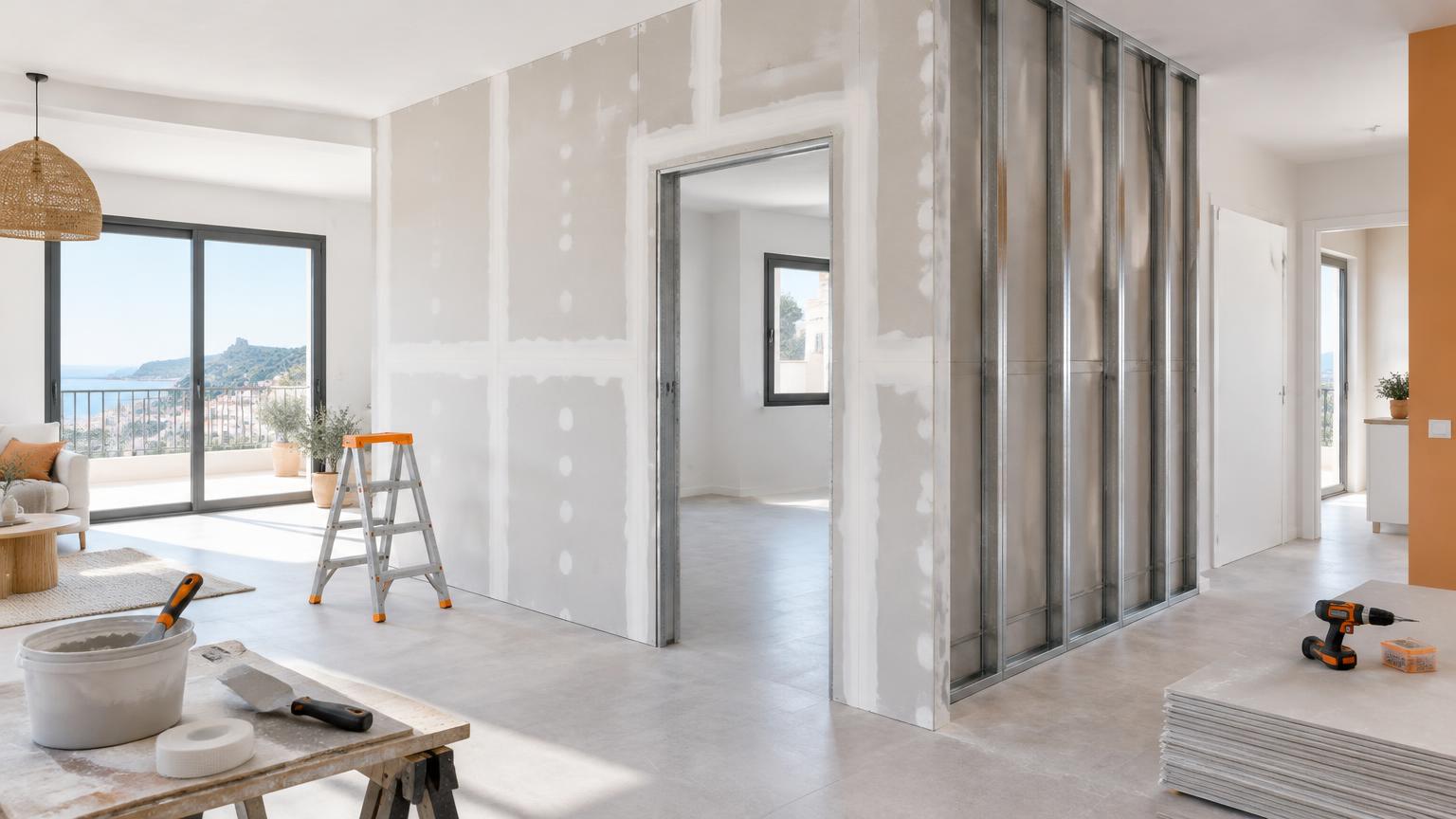
Choosing plasterboard or brick for an internal partition comes down to sound insulation, wall-mounted loads and how much disruption you can accommodate. Plasterboard generally makes for a lighter, quicker installation. Brick offers a robust masonry option, but usually involves more wet trades, drying time and waste.
In Spain, you will often hear plasterboard systems called pladur. Neither option is automatically better: a properly specified partition matters more than the material name. For a Costa del Sol renovation, compare complete wall constructions with equivalent finishes rather than choosing from the price of boards or bricks alone.
What are you actually comparing?
A plasterboard partition normally consists of gypsum boards screwed to a metal framework. Its cavity can accommodate mineral wool and services, while additional board layers can improve particular performance characteristics. Board type, frame dimensions and junction details all matter.
A brick partition uses clay masonry units laid with an appropriate mortar or bonding material. Spanish internal partitions frequently use hollow clay bricks rather than the solid bricks some overseas homeowners picture. The wall normally needs plaster or another suitable finish before decoration.
An internal partition is not a substitute for a load-bearing wall. Before removing an existing wall, establish its structural role and check for concealed services or shared building installations.
Do not assume that a thin wall is safe to demolish. In an older property, or where previous alterations are unclear, have a suitable building professional inspect it before work starts.
Pros and cons: installation, weight and usable space
Plasterboard often suits occupied homes because it reduces wet construction work, although cutting and sanding still create dust.
- Plasterboard advantages: relatively low weight, straightforward service routes, consistent surfaces and generally quick assembly.
- Plasterboard drawbacks: joints and junctions need careful workmanship, substantial loads need planning, and unsuitable fixings can fail.
- Brick advantages: a robust everyday surface, familiar masonry construction and good resistance to minor knocks.
- Brick drawbacks: greater weight, more wet work and waste, plus drying time before finishing. Chasing for cables or pipes adds labour.
Neither option always saves more floor space. Compare the finished wall thickness, including boards, framing and insulation, or brickwork and plaster. A high-performing acoustic partition may need more space whichever material is used.
A practical tip: discuss delivery access, lift restrictions and waste removal before choosing. Moving masonry materials through an occupied apartment block can affect the programme and labour cost, while large plasterboard sheets also need a workable access route.
Sound and thermal insulation: judge the whole wall
If you are dividing a bedroom from a living room, ask about the performance of the proposed wall assembly, not simply whether brick or plasterboard is quieter.
A plasterboard system with mineral wool, appropriate board layers and correctly sealed junctions can provide good sound insulation. Brickwork can also perform well, but a solid feel does not guarantee acoustic privacy. Sound may travel through adjoining floors, ceilings and walls, bypassing the partition.
- Request documented performance for the complete proposed system.
- Avoid placing electrical boxes directly opposite one another.
- Specify perimeter treatments and seals appropriate to the system.
- Check the door: a lightweight leaf or generous gaps can undermine the wall's performance.
For thermal insulation, an insulated cavity can help where a room adjoins an unconditioned space. If the problem concerns an external wall, the entire wall build-up and condensation risk need assessment. On the Costa del Sol, solar exposure, shading and ventilation also influence comfort; an internal partition alone will not resolve overheating.
Bathrooms, kitchen units and heavy wall-mounted items
Both systems can be used in bathrooms and kitchens when correctly specified. Moisture-resistant plasterboard is not waterproof. Shower areas may need a dedicated waterproofing system behind the finish, and brickwork does not prevent leaks by itself either.
For cupboards, televisions and basins, the key questions are the load, how far it projects from the wall and where the fixings transfer that load.
- Plan suitable reinforcement or support frames inside plasterboard partitions before boarding.
- Use fixings compatible with hollow masonry when attaching items to hollow clay bricks.
- Provide an appropriate supporting frame for wall-hung sanitaryware.
- Check the limits of both the wall system and its fixings rather than relying on a generic plug rating.
An extending television bracket places different demands on a wall from a picture frame. Give the installer a layout showing furniture, accessories and equipment before construction begins. Photographs of reinforcement and service routes before the wall is closed are useful for later maintenance, although they do not replace checks before drilling.
Indicative costs and how to compare quotations
For straightforward, non-load-bearing internal partitions, these indicative ranges per square metre of partition, measured on one face, can help with early budgeting:
- Plasterboard with metal framing, basic cavity insulation and treated joints: €45–€85/m².
- Brickwork with typical finishes to both sides: €50–€95/m².
- Plasterboard systems with enhanced acoustic specifications, specialist boards or reinforcement: €70–€120/m².
These are not fixed tariffs. Prices vary with specification, property condition and location, as well as access and project size. Small jobs can cost more per square metre because transport, setup and minimum labour charges are spread over less work.
Ask whether VAT, protection, deliveries, waste removal and final decoration are included. Compare walls taken to the same finishing stage: treated plasterboard joints do not necessarily mean a painted wall. Demolition, doors, electrical alterations and waterproofing may be separate items. The cheapest basic material does not automatically produce the cheapest completed renovation.
Planning the work: materials, checks and common mistakes
Use this sequence before ordering materials:
- Set the requirements: privacy, moisture exposure, likely impacts and hanging loads.
- Measure the layout, door openings and finished partition thickness.
- Locate services and check that the supporting structure suits the proposal.
- Specify a compatible system and follow its installation instructions.
- Coordinate services and reinforcement before closing or plastering the wall.
- Inspect alignment, junctions and joints, and allow suitable drying time before decorating.
Plasterboard work typically needs metal profiles, boards, screws, joint tape, compound, perimeter products and mineral wool where specified. Common tools include a level, screw gun, knife, metal snips and dust extraction. Brickwork needs masonry units, appropriate mortar and finishes, a trowel, straightedge, level, and suitable mixing and cutting equipment. Use eye protection, gloves and respiratory protection appropriate to the dust.
Avoid boarding over damp, mixing incompatible components or rushing decoration. Before working near electrical cables, switch off the relevant supply at the consumer unit and verify that it is dead using a suitable voltage detector. In Spain, new electrical installations and extensions require an authorised installer and the corresponding electrical certificate, commonly called a boletín, under the REBT. Gas work is never a DIY task: use a suitably authorised professional.
Which should you choose, and when should you call a professional?
Choose plasterboard when low weight, convenient service routes and a clearly specified acoustic construction are priorities. Brick may suit a conventional masonry approach where structural loading, wet work and drying times are manageable. Neither is the best answer for every room.
Get professional advice for suspected structural issues, persistent damp, heavy suspended loads, concealed services or demanding acoustic requirements. Walls separating different homes or communal areas also need more careful assessment than an ordinary room divider.
Request quotations based on equivalent thicknesses, performance and finishes. Check any municipal permissions or notifications and relevant community-of-owners approvals before starting, particularly in an apartment building.
If your property is on the Costa del Sol, ReformaClick can help you find renovation companies and request quotations without obligation, so you can discuss suitable options for the actual building rather than choosing on material price alone.
Frequently asked questions
Is plasterboard cheaper than brick?
It can be, but not in every specification. Plasterboard may reduce wet trades, while specialist boards and reinforcement increase costs. Compare complete quotations with equivalent insulation, finishes and included work.
Can you mount a television on plasterboard?
Yes, with a fixing arrangement suitable for the television, bracket and wall construction. An extending bracket increases the forces on the wall and may require internal reinforcement or attachment to suitable structural supports.
Which is better for soundproofing, plasterboard or brick?
Neither wins automatically. A properly installed plasterboard system with mineral wool can provide very good sound insulation. Compare complete tested constructions and consider doors, junctions and sound travelling around the partition.
Is plasterboard suitable for bathrooms in Spain?
Yes, provided the boards and complete system suit the moisture exposure. Wet areas need appropriate compatible waterproofing where required; moisture-resistant board alone is not a waterproof barrier.
Can I replace a brick partition with plasterboard?
Often, if the existing wall is genuinely non-load-bearing and the replacement meets the relevant requirements. First check its structural role, concealed services and any permissions. Wall thickness or a tapping sound is not enough to establish safety.
Would you rather hire a professional?
Tell us about your project and we will connect you with renovation companies on the Costa del Sol. No obligation.
Get a quote