
Kitchen Worktop Materials: Quartz, Porcelain, Granite or Wood
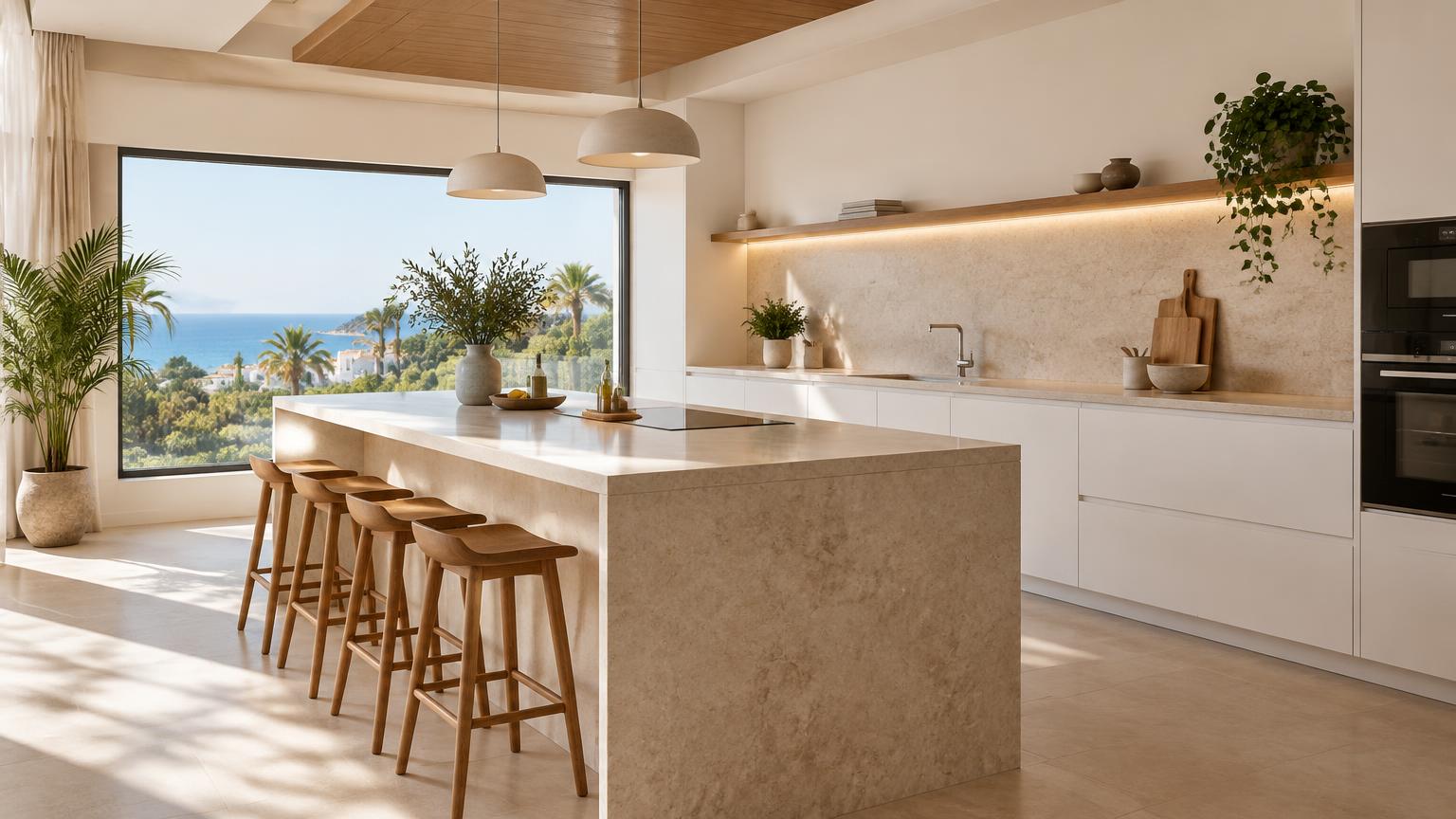
The best kitchen worktop material depends on your cooking habits, maintenance preferences and installed budget. Engineered quartz is easy to keep clean, porcelain handles heat well, granite offers natural character and durability, and timber provides warmth with the potential for refinishing.
For a home on the Costa del Sol, think about who will use the kitchen and how often: a holiday rental has different priorities from a year-round family home. Here is an honest comparison of the four materials, including their weaknesses, indicative costs in Spain and the installation details worth checking before ordering.
1. Start with how you actually use your kitchen
Rather than choosing from a small colour sample, picture a normal week in your kitchen. Do you cook daily, leave washing-up beside the sink or regularly move heavy pans across the worktop? These habits matter more than a material's showroom appearance.
- Engineered quartz: low porosity, straightforward cleaning and consistent designs. Concentrated heat can damage its resin binders.
- Porcelain: very low water absorption and good resistance to heat and common stains. Exposed edges can chip under impact.
- Granite: hard-wearing natural stone with individual markings. Absorption varies, so some slabs need more stain protection than others.
- Timber: warm to the touch and potentially renewable through sanding. Standing water and neglected finishes are its main vulnerabilities.
A useful starting point: rank easy cleaning, heat resistance, appearance and repairability in order of importance. Low-maintenance surfaces often suit rental properties, while solid timber may appeal more if you enjoy caring for natural materials. No option eliminates the need for chopping boards, sensible cleaning and a properly supported installation.
2. Engineered quartz: easy care, with a heat limitation
Engineered quartz combines mineral particles with resins and pigments. It is not the same as natural quartzite, a different stone with its own properties and pricing. Formulations vary, so ask for the technical and care information for the actual product being quoted.
Its low-porosity surface makes everyday grease, coffee splashes and food residue relatively easy to remove. It generally does not need sealing. Warm water, mild detergent and a soft cloth are usually enough, followed by rinsing away any residue.
Its main drawback is concentrated heat. A pan straight from the hob, or an appliance that gets hot underneath, can cause damage that is difficult to disguise. Use heat-resistant trivets and follow the appliance manufacturer's clearance instructions.
- Avoid abrasive pads and aggressive chemicals unless specifically approved.
- Use a chopping board rather than cutting directly on the surface.
- Do not assume it is suitable for an outdoor kitchen; check approval for sunlight and exterior exposure.
Quartz is a sensible choice for a coordinated, easy-care kitchen, provided everyone using it understands that a tough surface is not necessarily heatproof.
3. Porcelain: strong performance, vulnerable edges
Porcelain worktops absorb very little water and resist domestic heat and many everyday stains well. Nevertheless, heat-resistant does not mean indestructible. Trivets remain a sensible precaution against sudden temperature differences and help protect joints and nearby components.
Impact is a different issue. Dropping a heavy saucepan against an exposed corner or sink edge can cause chipping, and an invisible repair is not always achievable. Transport, cutting and support over the cabinets all require careful planning.
Before placing an order, check:
- Whether the pattern runs through the edge or is mainly on the surface.
- Where joints will fall and how veining will line up.
- The thickness, backing and reinforcement required for that product.
- How clearly the finish shows fingerprints, grease or water marks.
Products sold as sintered surfaces do not all have identical compositions or technical characteristics. Compare the specific product data rather than assuming every label means the same thing. For routine care, start with a mild cleaner and take particular care when handling heavy cookware around cut-outs.
4. Granite and timber: natural materials with different needs
Granite stands up well to everyday wear and heat, although trivets are still advisable to reduce thermal shock risks. Its markings vary between slabs. If the pattern is central to your design, ask to view the available slab or suitable photographs before cutting is authorised.
Whether it needs an impregnating sealer depends on the stone and its existing treatment. Ask the supplier how to assess absorption and when protection should be renewed. Sealing helps resist stains; it does not make every stone completely impervious. Wipe up oil and coloured liquids promptly and use stone-compatible cleaning products.
Timber needs closer attention around sinks. Standing water, failed joints and dishwasher steam can lead to staining, movement or deterioration. Cut edges and other faces specified by the manufacturer need protection, not just the visible top.
Solid wood may be sanded and refinished if enough material remains; a thin veneered surface offers much less scope. Choose an oil or coating intended for worktop use and observe its curing time before use. Renewing protection according to wear is more reliable than following a universal maintenance timetable.
5. Indicative prices and what a quotation should include
For early budgeting, the following are broad ranges per linear metre, based on a roughly 60–65 cm depth and supply with basic fitting in Spain. Costs vary with quality, kitchen condition, location, availability and complexity:
- Engineered quartz: €220–€500 per linear metre.
- Porcelain: €300–€700 per linear metre.
- Granite: €180–€450 per linear metre.
- Solid timber: €150–€400 per linear metre.
Premium slabs, deep islands and complicated fabrication can exceed these ranges. A square-metre rate cannot always be converted directly into a linear-metre price: slab utilisation and minimum fabrication charges also affect the total.
Ask each company to state whether IVA, Spain's VAT, measuring, delivery, fitting, cut-outs, edge finishing and sealing are included. Check removal of the old worktop, waste disposal, reconnections and any special lifting arrangements separately.
For a fair comparison, give every contractor the same sketch and request the same material, thickness, finish and number of openings. A cheaper headline figure may exclude an undermount sink cut-out, reinforced overhangs or difficult access to an upper-floor flat.
6. Measuring, fitting and common mistakes to avoid
Even a high-quality worktop can disappoint if the installation is poor. Final templating should take place after the cabinets are installed, levelled and secured, with the exact sink and hob models confirmed.
- Draw a preliminary plan: note lengths, depths, corners, columns and overhangs. A tape measure, pencil and spirit level are enough for initial planning.
- Check the base units: ask the fitter to assess cabinet condition and reinforcement needs. Do not assume existing units can support any replacement material.
- Agree the details: confirm joints, edge profiles, upstands, tap position and openings. Keep the appliance templates available.
- Specify compatible materials: sealant, adhesive, supports and any stone treatment or timber finish must suit the chosen system.
- Inspect the finished work: check for damage, stable support, neat joints and complete seals. Check for leaks after the sink is reconnected.
Common mistakes include ordering before cabinets are fitted, leaving unsupported overhangs and overlooking tap clearance. Do not cut or sand stone, quartz or porcelain at home. Dust may contain respirable crystalline silica. Fabrication requires professional dust-control measures; an ordinary DIY mask is not an adequate solution.
7. When to bring in a professional
Use specialist fabricators for final templating, cutting and fitting stone, quartz or porcelain. Large pieces are heavy and vulnerable during handling, while poorly positioned cut-outs can weaken the surface. Professional help is also worthwhile for timber worktops with undermount sinks, complicated joints or damaged cabinets beneath them.
If an electric hob needs disconnecting, isolate the power at the consumer unit and verify that it is dead using a suitable voltage detector. If you cannot do this safely, do not attempt the work. In Spain, new electrical installations and extensions require an authorised installer and the appropriate electrical certificate, often called a boletín, under the REBT. Gas work is never a DIY task: use an appropriately authorised professional.
Before accepting a quotation, request a written scope, material-specific care instructions and an explanation of joint placement. If your property is on the Costa del Sol, ReformaClick can help you find renovation companies and request quotations without obligation.
Frequently asked questions
Is quartz or porcelain better for a kitchen worktop?
Quartz offers easy cleaning and consistent designs. Porcelain generally handles intense heat better but needs care around exposed edges. Compare the actual products, installation requirements and your cooking habits rather than choosing on one feature alone.
Can you put hot pans directly on granite?
Granite tolerates heat well, but a sudden temperature change can still cause problems. A trivet is a simple precaution, particularly near joints, repaired areas and cut-outs.
Which worktop material needs the least maintenance?
Quartz and porcelain usually need little beyond suitable cleaning. Granite may require an impregnating sealer depending on its absorption, while timber needs its protective finish renewed as it wears.
Can I replace a worktop without replacing the kitchen units?
Yes, if the units are sound, level and capable of supporting the new installation. The fitter should also check openings, services and whether removing the old worktop could damage the wall finish.
Is a wooden worktop practical around a sink?
It can be, with suitable detailing, protected cut-outs and a properly maintained finish. You must wipe away standing water promptly. It is less suitable if puddles are likely to remain or minimal maintenance is the priority.
Would you rather hire a professional?
Tell us about your project and we will connect you with renovation companies on the Costa del Sol. No obligation.
Get a quote