
Insulate a Wall with Plasterboard and Mineral Wool
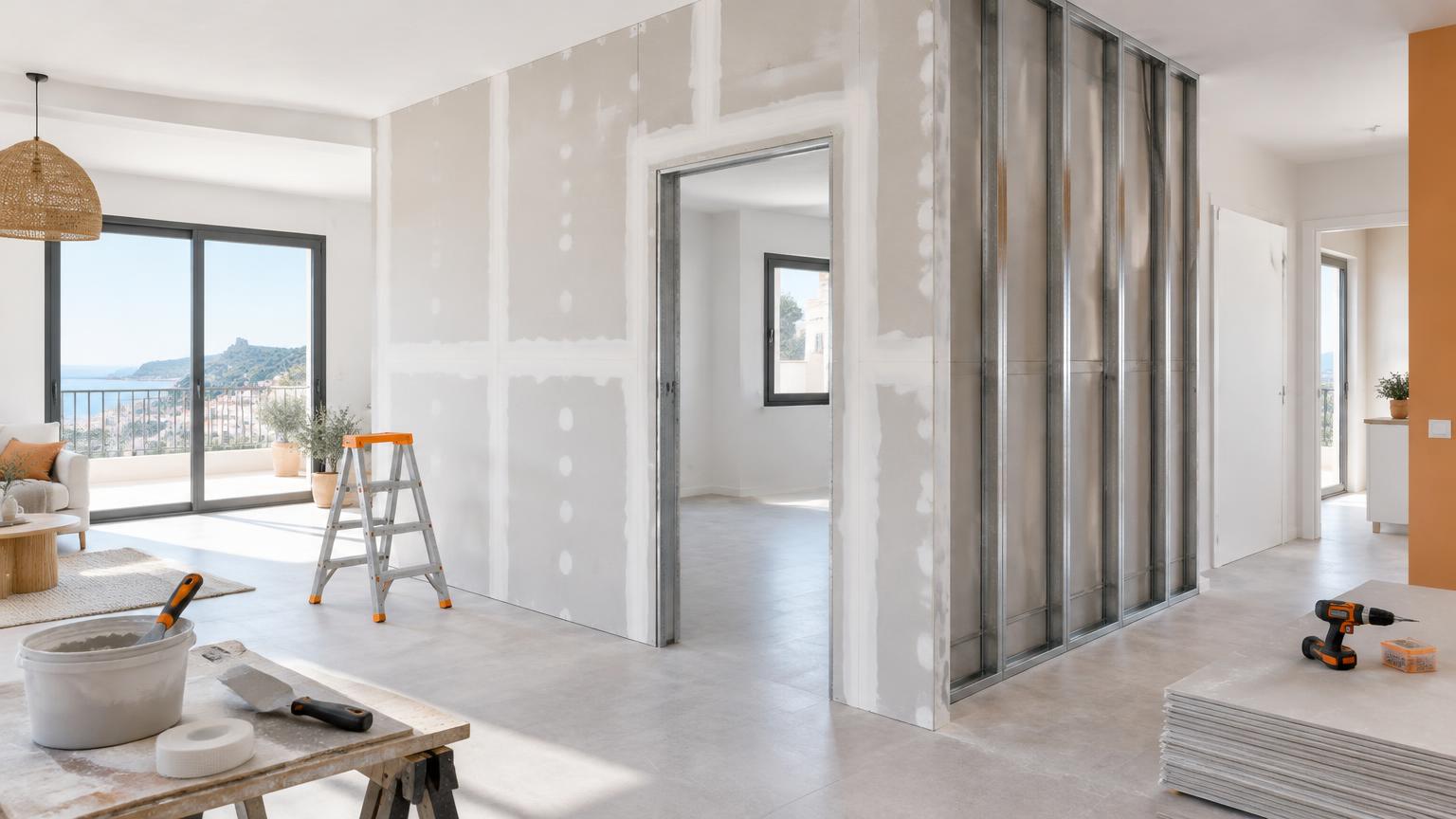
To insulate a wall with plasterboard, a common approach is to build a metal-framed lining in front of the existing wall, fit mineral wool within the frame and finish with plasterboard. A properly specified lining can reduce heat loss, limit heat entering through the wall in summer and improve sound insulation. Its performance depends on the entire construction, not just the board.
For homes on the Costa del Sol, start by establishing what actually needs fixing: a sun-heated external wall, a cold bedroom, noise from next door or a combination of problems. Check for damp before covering anything. This guide explains the materials, installation sequence and details worth discussing with your contractor.
1. What plasterboard and mineral wool can achieve
Plasterboard provides the finished surface and adds mass, while mineral wool slows heat transfer and absorbs sound within the cavity. The metal framework supports the lining. Continuous insulation and carefully sealed junctions are essential to getting useful results.
- Winter comfort: insulating an external wall reduces heat loss and can make its room-side surface warmer.
- Summer comfort: it limits heat entering through that wall, but does not replace external shading, shutters or roof insulation.
- Neighbour noise: a suitable lining can reduce airborne sound, such as speech and television, passing through the treated wall.
It will not necessarily solve impact noise, vibration or sound travelling through adjoining floors, ceilings and walls. Nor can a contractor reliably promise a particular decibel reduction without specifying a tested construction and considering the building. If a poorly sealed window is the main sound path, treating the wall first may offer disappointing value.
2. Check damp, available space and the existing wall
Look for staining, peeling paint, salt deposits, musty smells and mould, especially behind furniture and at floor level. Penetrating or rising damp must be addressed before the wall is lined. Concealing it can leave ongoing damage hidden inside the new construction.
- Measure the wall and mark columns, sockets, pipework and skirting boards.
- Check how much room depth you can lose without obstructing doors, wardrobes or radiators.
- Inspect window reveals and floor and ceiling junctions for gaps and likely thermal bridges.
- Establish whether the wall faces outdoors, a communal area or another home.
Internal insulation changes the temperature of the original wall and may increase the risk of condensation within the construction. Do not add a vapour barrier automatically. Whether a vapour-control layer is needed, and its position and permeability, depend on the existing wall, local conditions and heating or air-conditioning patterns. Ask for a technical assessment if the build-up is uncertain.
3. Choosing materials and gathering tools
Specify a compatible system and follow its installation documentation. A free-standing metal lining, independent of the original wall where the system allows, generally offers more scope for acoustic separation than a lining rigidly connected to that wall.
Typical materials include:
- Metal tracks and studs suitable for plasterboard linings.
- Resilient strips at the specified contact points.
- Semi-rigid stone wool or glass wool intended for wall linings.
- Compatible plasterboard, screws, joint tape and jointing compound.
- Flexible sealant for the relevant perimeter joints and penetrations.
- Reinforcement for planned cupboards, radiators or other loads.
Useful tools include: a tape measure, spirit or laser level, service detector, metal snips, drill, screw gun, utility knife and jointing tools. Wear gloves, eye protection and long sleeves, with respiratory protection appropriate to the dust and the manufacturer's guidance.
Do not select mineral wool by density alone: thermal conductivity, thickness and tested system performance matter. Moisture-resistant plasterboard is useful in appropriate locations, but it does not repair leaks or replace waterproofing.
4. How to install the insulated lining
- Prepare the area. Remove obstructions, resolve damp sources and clean the working area. Locate concealed services before drilling.
- Set out the finished wall. Mark its position on the floor and ceiling, allowing for the frame, board layers and specified clearance from the existing wall.
- Install the framework. Use the specified resilient strips and fixings suitable for the substrate. Follow the system's stud spacing, height limits and bracing requirements; do not improvise wall connections.
- Plan services and loads. Arrange sockets, cable routes and reinforcement before the lining is closed.
- Fit the mineral wool. Cut it to fit closely without gaps or excessive compression. Maintain the intended thickness around services.
- Fix the plasterboard. Follow the specified screw and joint spacing. Stagger joints between layers where the construction requires it.
- Seal and finish. Treat junctions and penetrations, tape the joints, apply compound, allow it to dry, then sand and prime before painting.
Electrical safety: before working near wiring or accessories, switch off the electricity at the consumer unit and verify that the circuit is dead using a suitable voltage detector. In Spain, new electrical installations and extensions require an authorised installer and a certificate, commonly called a *boletín*, under the REBT. Never attempt DIY gas work: alterations belong to a qualified gas professional.
5. Details that make the difference
The most valuable practical tip is to plan every junction before closing the lining. Good mineral wool cannot compensate for open edges, unplanned connections or poorly fitted boards.
- Avoid squeezing insulation into an undersized cavity. Use a thickness that fits the specified construction rather than compressing a thicker slab.
- Avoid unintended rigid bridges. Extra screws or improvised supports can transmit vibration and undermine acoustic separation.
- Treat sockets as weak points. Use service-box and penetration details compatible with the system, and avoid opposing boxes where relevant.
- Consider columns and window reveals. Insulating only the broad wall surface may leave significant thermal bridges at its edges.
- Prepare for heavy fittings. Wall cupboards, televisions and radiators need suitable reinforcement or a designed fixing arrangement.
Photograph service routes and reinforcement before boarding so they can be located later. Keep the home adequately ventilated after the work: insulation does not remove the moisture produced by showers, cooking or drying laundry indoors.
6. Room space and indicative installation costs
A typical insulated lining may take up around 7–12 cm from the existing wall to the finished surface, although some specifications need more. The total depends on clearance, frame depth, insulation and the number of board layers. Ask for the full build-up rather than just the mineral wool thickness.
As a broad guide, a metal-framed lining with mineral wool and plasterboard may cost around €45–€85 per m² installed. More demanding acoustic specifications, additional board layers or complicated junctions may fall around €70–€120 per m², or above. These are indicative ranges and vary with material quality, existing condition and location. Small jobs often cost more per square metre.
Check whether quotations include VAT, decorating, waste removal, skirting boards and socket alterations. Compare equivalent constructions: the insulation, board layers and perimeter treatment can differ substantially between two apparently similar square-metre prices.
7. When to bring in a professional
An experienced DIYer may be comfortable tackling a straightforward, dry wall with no services to alter, provided they follow a defined system. Bring in a specialist where there is persistent damp, condensation, significant noise, excessive wall height or affected services.
For noise problems, ask the contractor to identify the main transmission paths before recommending a lining. For internal insulation on an external wall, request consideration of thermal bridges and condensation risk. A single treated wall may not be enough if the roof or several other walls are responsible for most of the discomfort.
Request an itemised quotation stating the complete wall build-up, preparation, junction details, finishes and exclusions. Be wary of promises to eliminate all neighbour noise without inspecting the property. If your home is on the Costa del Sol, ReformaClick can help you find renovation companies and request a quotation without obligation.
Frequently asked questions
Can I insulate a wall by sticking plasterboard directly to it?
Plain plasterboard bonded to masonry provides little thermal insulation on its own. Insulated plasterboard products are available, but they are not equivalent to a mineral-wool stud lining. Suitability depends on the substrate, moisture conditions and acoustic requirements.
Is stone wool or glass wool better for wall insulation?
Both can work well. Compare products intended for wall linings by thermal conductivity, thickness and performance within the proposed system. A higher density or a particular material name does not automatically mean better results.
How thick should the mineral wool be?
There is no universal thickness. It depends on the existing wall, available space and thermal or acoustic target. Ask for a justified complete specification: adding insulation without addressing gaps and junctions may deliver less improvement than expected.
Will a plasterboard lining stop noise from next door?
It may reduce speech and television noise travelling through the treated wall. Sound can also bypass it through floors, ceilings and adjoining walls, while impacts and vibration often require different measures. Diagnose the main sound paths before choosing the construction.
Can I cover a mouldy wall with mineral wool and plasterboard?
Not before identifying and resolving the cause and treating the affected surface. Mould may be linked to leaks, condensation or thermal bridges. If it is extensive or keeps returning, arrange a professional assessment before lining the wall.
Would you rather hire a professional?
Tell us about your project and we will connect you with renovation companies on the Costa del Sol. No obligation.
Get a quote