
Home Consumer Unit: RCDs, Circuit Breakers and Faults
Your home consumer unit, often called a fuse box and known in Spain as the *cuadro eléctrico*, distributes electricity to the property's circuits. Its protective devices disconnect the supply when they detect particular faults. RCDs respond to current leakage; circuit breakers protect against overloads and short circuits. Knowing which device has tripped is useful, but it does not establish the cause.
In a Spanish property, the labels and layout may differ from those you know in the UK. You can inspect the closed front and operate accessible switches if everything is dry, intact and free from warning signs. Do not remove the cover or touch wiring or terminals. This guide explains what to look for, which basic checks are reasonable and when to call an authorised electrician.
Understanding the switches in a Spanish consumer unit
The consumer unit is often near the entrance, although older homes and refurbished properties can have different arrangements. Do not assume that every board contains the same devices or follows the same layout.
- IGA — main circuit breaker: protects against overloads and short circuits and disconnects the circuits supplied through it.
- Diferencial — residual current device, or RCD: detects an imbalance between outgoing and returning current, which can indicate leakage.
- Magnetotérmicos or PIAs — miniature circuit breakers, or MCBs: protect individual circuits serving lighting, sockets or particular appliances.
- Overvoltage protection: where fitted, limits or disconnects certain voltage increases, depending on the device type.
- ICP — power control switch: may be visible in older installations. In many current supplies, its function is built into the electricity meter.
Practical tip: keep a photograph of the closed front and a circuit list. Read the visible labels rather than identifying a device solely by its position.
RCD versus circuit breaker: what each one protects
An RCD usually has a button marked ‘T’ or ‘TEST’. It compares current flowing through the live conductors and disconnects when the imbalance reaches its operating threshold. It helps protect against certain electric shock risks, but does not replace earthing or make every electrical situation safe.
An MCB trips when a circuit carries too much current for too long or experiences a short circuit. A marking such as C16 identifies its tripping characteristic and rated current. Fitting a higher-rated breaker to stop nuisance tripping is dangerous: the existing cables may no longer be adequately protected.
Some devices combine both functions. Check the documentation or ask an electrician if identification is unclear. One RCD may also serve several circuits, so a whole-home power cut does not automatically mean the main breaker has operated.
Use the RCD test button according to its manufacturer's instructions. If it does not trip while the supply is present, arrange professional attention rather than assuming the protection is working.
Safety checks before operating any switches
For an initial assessment, you only need a battery-powered torch, a phone and something to take notes on. Leave screwdrivers in the toolbox. Check which areas have lost power, read the labels and find out whether communal areas or neighbouring properties are also affected.
If you notice burning smells, smoke, crackling, broken parts, abnormal heat or nearby water, do not reset or handle the board. Seek urgent assistance. If there is a fire or immediate danger, move away and call 112. Never use water on an electrical fire.
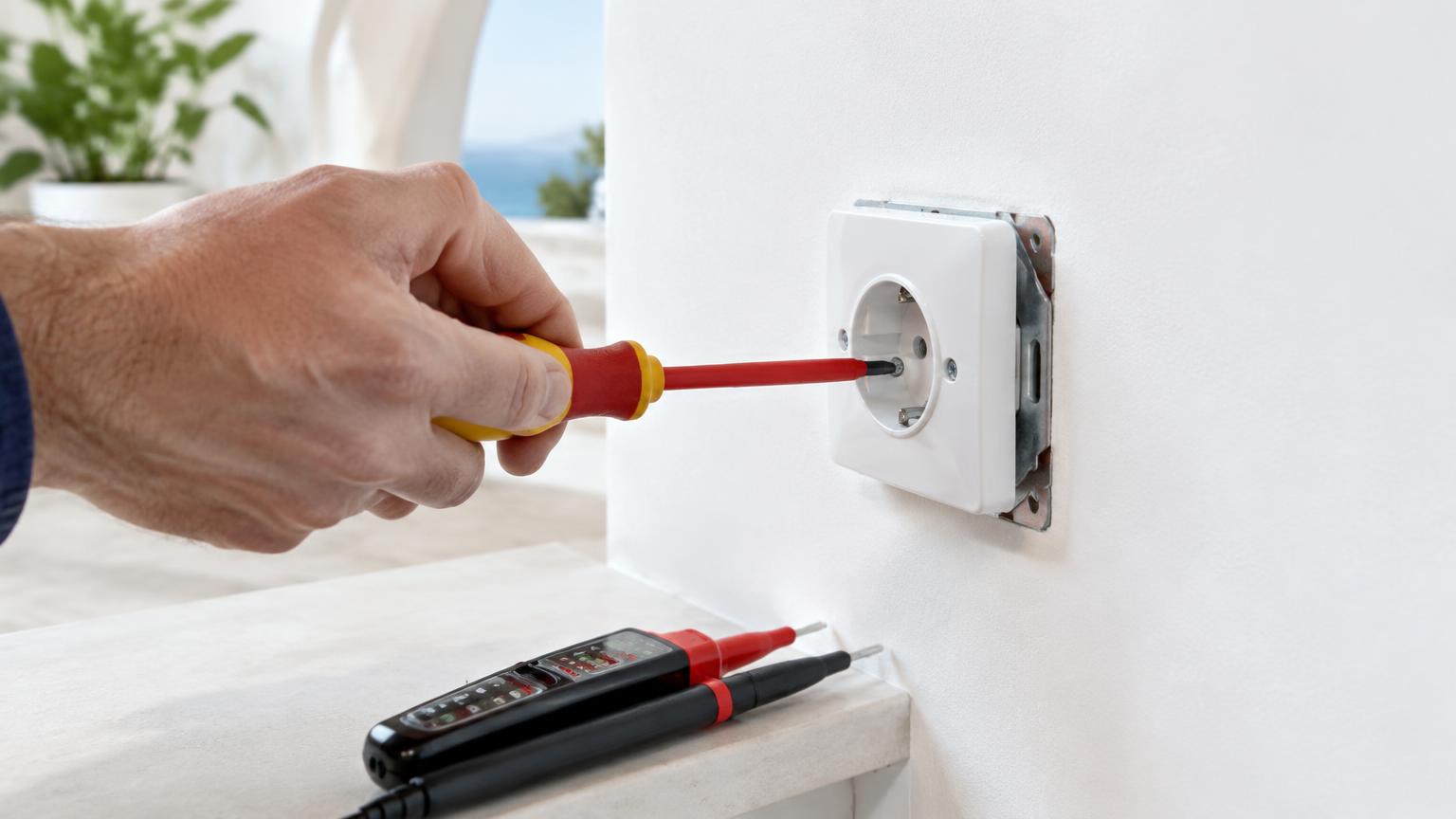
Before electrical work, the supply must be switched off at the consumer unit and the absence of voltage verified using a suitable voltage detector, preferably a two-pole tester used by a competent person. A neon screwdriver or non-contact detector alone cannot establish that equipment is dead.
Even with the main switch off, incoming parts inside the board may remain live. The checks below involve external controls and safely unplugging accessible appliances only, not opening equipment.
What to do when an RCD or circuit breaker trips
Only follow this sequence if there are no warning signs, the enclosure is intact and you can confidently identify the accessible controls.
- Record which device has tripped and what was running. A tripped handle may sit between its on and off positions.
- For an MCB trip, switch off and unplug accessible appliances on the affected circuit, using dry hands in dry surroundings. Do not pull out built-in appliances or handle damaged sockets.
- For an RCD trip, switch off the downstream MCBs only if you can identify them reliably.
- Make one reset attempt on the tripped device, following its operating instructions. The handle may need to move fully to off before it can be switched on.
- If the RCD holds, restore its circuits individually. If it trips again, stop, leave the last circuit switched off and arrange an inspection.
Do not repeatedly reset a device or reconnect a suspect appliance to prove that it is faulty. This process can narrow down the affected area, but it is not a diagnosis. Fixed equipment and persistent faults need an electrician.
Common causes of tripping and mistakes to avoid
Several powerful appliances are running. The problem may be an overloaded circuit or disconnection because demand exceeded your contracted supply capacity. Identify what operated: increasing contracted power will not fix an overloaded circuit.
Trips happen during wet weather. Outdoor lighting, terrace sockets or equipment may have moisture-related leakage. Do not handle wet fittings. Coastal homes on the Costa del Sol warrant particular attention to equipment exposed to damp and salt-laden air.
Power disappears but every switch remains on. There may be a meter-related disconnection, a network outage or another fault. Check information from the electricity distributor and follow its instructions. Never open sealed compartments.
Tripping seems random. Intermittent insulation faults or combined leakage from several appliances can require instrument testing. Replacing components by guesswork is not a reliable solution.
Avoid these dangerous shortcuts:
- Bypassing an RCD or holding a switch in position.
- Increasing breaker ratings without checking the wiring.
- Daisy-chaining extension leads for high-power appliances.
- Tightening internal connections or replacing devices without appropriate competence.
Routine care, materials and indicative costs
Keep the consumer unit accessible, inspect its closed front and test the RCD at the intervals specified by its manufacturer. Warn everyone before testing, as computers, alarms and other equipment may lose power. If essential medical equipment depends on the supply, arrange suitable continuity before carrying out a test.
Useful household materials are limited to clear labels and an accurate circuit schedule. Ask the electrician to identify unlabelled circuits during an inspection. Do not spray cleaning products onto the board or insert anything through its openings.
For electrical work, the electrician should select compatible protective devices, enclosure, connections and conductors. Avoid buying a ready-made replacement board before the installation has been assessed.
As a broad guide, inspection and fault diagnosis might cost €80–€200, while replacing or reorganising a domestic consumer unit might be €350–€900, with more involved work exceeding these ranges. Prices vary with specification, existing condition, location, access and urgency.
Ask whether the quotation includes materials, labour, testing, taxes and certification. Wiring repairs or improvements to earthing may be additional items.
When to call an authorised electrician in Spain
Arrange professional help for repeated trips, an RCD that fails its test, unusual buzzing or visible damage. A tingling sensation or shock from an appliance is also a reason to stop using it and request an inspection, even if no protective device has operated.
Have the installation assessed before adding substantial electrical loads, refurbishing a kitchen or bathroom, or installing EV charging. The electrician should consider wiring, protective devices, earthing and available capacity together, rather than simply finding a spare slot in the board.
In Spain, new electrical installations and extensions require an authorised installer and the corresponding electrical installation certificate, commonly called a boletín, under the REBT framework. Ask the installer to confirm the certification and administrative requirements for your particular project.
When requesting quotations, provide photographs of the closed front, the approximate installation age, symptoms and details of appliances running when the fault occurs. On the Costa del Sol, ReformaClick helps you find renovation companies and request quotations without obligation.
Frequently asked questions
Why does the RCD trip when everything is unplugged?
Fixed appliances may still be connected, or there may be moisture, damaged insulation or a fault in the protective device. Unplugging visible appliances does not isolate the entire installation. If the problem persists, leave the protection off and arrange professional diagnosis.
How do I know which breaker controls each room?
Circuits usually group electrical uses rather than individual rooms, so one room may be supplied by several breakers. Check the labels and any circuit schedule. If these are missing or unreliable, ask for proper identification and labelling rather than guessing from switch positions.
Can I replace the RCD myself?
This is not a suitable DIY job. It requires correct device selection, safe isolation and verification with appropriate test instruments afterwards. Incoming parts can also remain live when the main switch is off. Use an authorised electrical installer.
How often should I press the RCD TEST button?
Follow the interval stated on the device or in the manufacturer's instructions. With the supply present, pressing the button should trip the RCD. This functional check does not replace an inspection or verify earthing and every aspect of protective performance.
Does an old Spanish fuse box always need replacing?
Age alone is not enough to decide. Its condition, protection, wiring, earthing and the property's current requirements need assessment. A new consumer unit will not automatically correct faults elsewhere in the installation, so request an overall evaluation before replacing it.
Would you rather hire a professional?
Tell us about your project and we will connect you with renovation companies on the Costa del Sol. No obligation.
Get a quote