
Hanging Heavy Items on Plasterboard: Safe Fixings
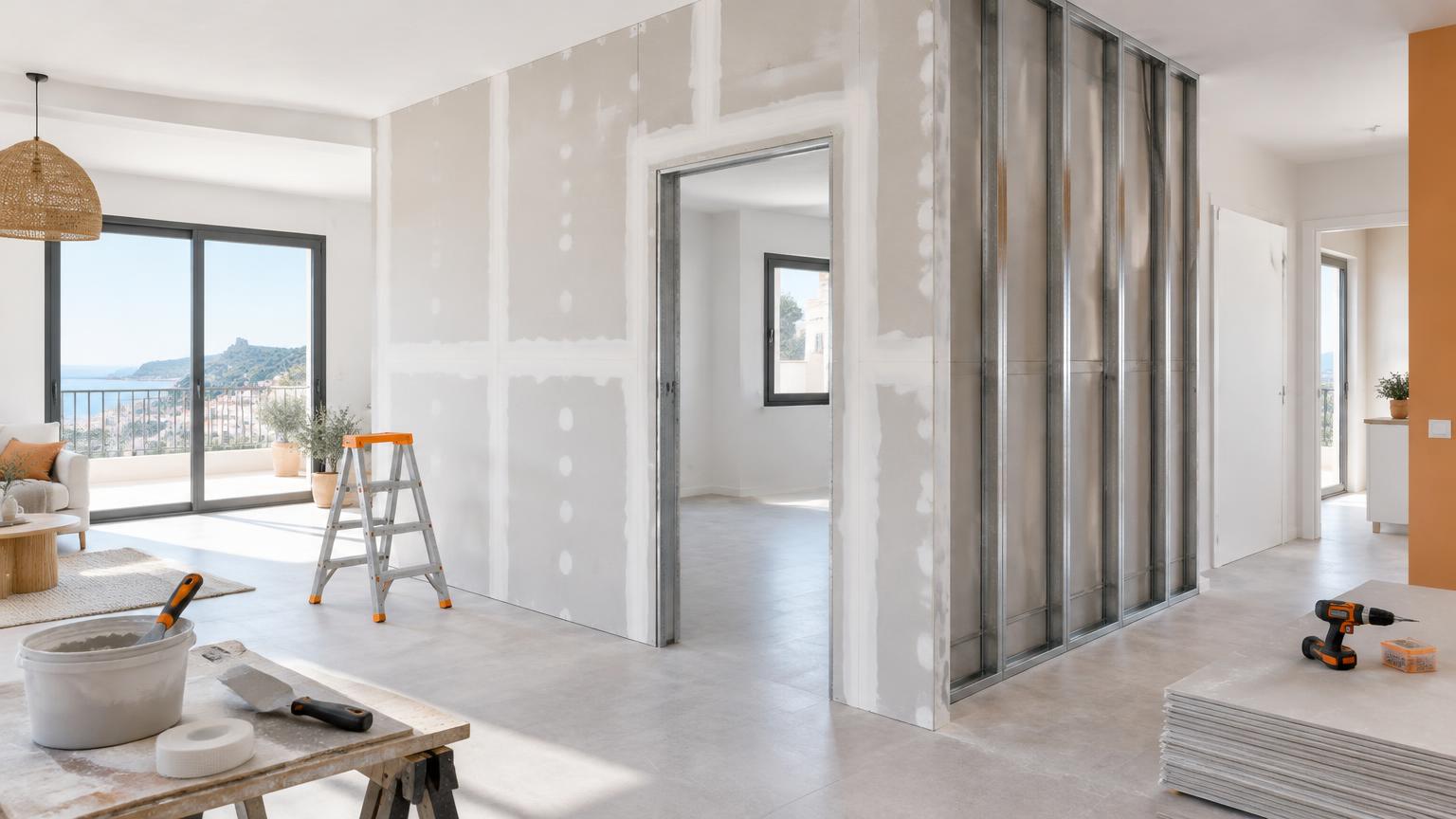
To hang heavy items on plasterboard safely, you need to understand the wall as well as the fixing. The weight rating on a packet is not enough: board thickness, cavity depth, bracket design and how far the load projects from the wall all affect the installation.
For homeowners on the Costa del Sol, plasterboard is often referred to as *pladur*. Suitable cavity fixings can support many everyday items, but loaded cabinets, moving brackets and anything whose failure could injure someone may need verified structural support or reinforcement. This guide explains what to check, which fixings to consider and when to bring in a professional.
1. Identify the wall construction first
A painted plasterboard surface tells you very little about what is behind it. You might have metal framing, a lined masonry wall or a cavity with more than one layer of board. Board thickness, condition and the available space behind it all influence the fixing choice.
Before buying anything:
- Look for construction drawings, renovation photographs or details of the wall system.
- Use a suitable detector to locate possible framing, checking from several directions.
- Inspect for damp patches, bulging, cracks and previous repairs.
- Check for concealed electrical cables and plumbing.
Tapping the wall cannot establish its load capacity. Finding metal is not proof of a suitable anchor point either: it could be thin framing, a pipe or another concealed component.
If you cannot establish the board thickness or cavity depth, do not simply choose a longer fixing. Cavity anchors need the correct grip range and enough room to open. For a demanding installation, identifying the construction is part of the job rather than an optional precaution.
2. Assess the full load and the leverage
Include the item, its bracket and everything it will hold. A kitchen wall unit must support its contents as well as the empty cabinet; a bookshelf must be assessed with books on it. Opening doors, adjusting a screen or accidentally leaning on a shelf also creates forces that a static weight figure does not describe.
The further the load projects from the wall, the greater the leverage. This increases the pull on upper fixings. An extended TV arm therefore places different demands on the wall from a flat bracket carrying the same television.
There is no universal safe weight limit for plasterboard. Check the manufacturer's permissible load for the actual board type, thickness, anchor arrangement and load direction. A laboratory failure load is not a safe working load.
Nor can you automatically multiply one fixing's rating by the number fitted. Loads may not be shared equally, and closely spaced anchors can damage the same area of board. Where the relevant technical information is missing, use a different support arrangement or obtain professional advice rather than guessing.
3. Match the cavity fixing to the wall
Choose a fixing expressly suitable for plasterboard, with a grip range matching the total board thickness. Check the clearance it needs behind the board and any restrictions on spacing or installation.
Common options include:
- Self-drilling plasterboard fixings: suitable for some light, static applications where the technical data allows. They are not a default choice for cabinets or televisions.
- Metal cavity anchors, often called Molly fixings: these expand behind the board. They must match its thickness and be set as instructed; some need a dedicated setting tool.
- Toggle anchors: these open within the cavity and require sufficient unobstructed space. Insulation or other obstacles may prevent correct deployment.
- Fixings into designed reinforcement or verified structural backing: appropriate for more demanding loads when both the support and connection are properly specified.
An ordinary expansion plug intended for brick or concrete should not be used in hollow plasterboard unless it is explicitly approved for that application.
Use the screw specified for the anchor. A thicker or longer screw is not automatically stronger in practice and may stop the fixing working correctly or reach concealed services. Read the installation conditions, not just the weight claim on the packaging.
4. Tools and a safe installation sequence
Gather a suitable wall and services detector, tape measure, spirit level, pencil, drill, correctly sized bit, screwdriver and compatible fixings. Add the specified anchor-setting tool where needed, plus eye protection and appropriate dust protection.
- Position the bracket. Mark the fixing holes required by its manufacturer. Follow the system's minimum distances from edges, joints and neighbouring anchors.
- Check for services. Scan the area and consider likely cable and pipe routes. A detector reduces uncertainty but cannot guarantee that a wall is clear.
- Address electrical risk. Before drilling where cables may be present, switch off the electricity at the consumer unit and verify absence of voltage with an appropriate detector. If you cannot establish that the area is safe, do not drill.
- Drill without hammer action. Use the specified diameter and control the depth. An oversized hole can compromise the fixing.
- Fit and set the anchor exactly as instructed. It should sit correctly without spinning freely or sinking into the surface.
- Attach the bracket with controlled tightening. Stop if the paper tears, the board crushes or the fixing moves.
- Mount the item as directed, getting help for bulky objects. Never test an installation by hanging from it or giving it sharp pulls.
If the project involves extending the electrical installation or creating a new one, Spain requires an authorised installer and the corresponding electrical certificate, commonly called a *boletín*, under the REBT. Gas work is never a DIY task: leave it to an appropriately authorised professional.
5. Practical approaches for shelves, TVs and cabinets
For pictures and mirrors, inspect the item's own hanging fittings as well as the wall anchors. A secure wall fixing cannot compensate for a damaged wire, weak eyelet or unsuitable mounting plate.
With deep shelves, consider the shelf brackets and anchors as a complete system. Keeping heavier objects nearer the wall reduces leverage, but it does not make an inadequate installation safe. Follow the shelf system's loading and fixing requirements.
An articulating TV bracket often calls for reinforcement or verified structural backing. Simply finding and screwing into a metal stud does not establish adequate strength: the profile thickness, screw specification and wall construction all matter.
Loaded wall cabinets and floating furniture may require noggins, reinforcement boards or purpose-designed supports connected to the framing. A hanging rail can distribute forces, but it does not replace a suitable supporting wall.
Do not transfer wall-fixing assumptions to ceilings. Suspended plasterboard ceilings have different loading conditions. Heavy suspended objects, fans and vibrating equipment require an assessment of the structural attachment and any dynamic forces.
6. Common mistakes and indicative costs
Frequent mistakes include choosing the wrong anchor, overtightening, reusing damaged holes and placing fixings too close together. Adhesive is not a general substitute for a necessary mechanical connection: the paint or paper face may peel away while the adhesive remains intact.
If a fixing spins or the hole crumbles, do not fill it with ordinary decorating filler and screw back into it. The damaged area needs assessment, repair and a fixing arrangement appropriate to the resulting support.
For budgeting, a small selection of cavity fixings may cost around €5–€30. A straightforward professional installation might fall around €60–€180, while opening the wall, adding reinforcement and closing it again may be around €180–€500, with complex work exceeding that range. These are indicative ranges only and vary with material quality, wall condition, location and scope. Check whether travel, materials, decoration and VAT are included.
A useful professional tip: photograph any reinforcement before the wall is closed and record its position. This makes future installations easier to plan and reduces the need for exploratory holes.
7. When to call a professional
Arrange an assessment if the wall construction is unknown, there is damp or damage, or reinforcement is needed. Loaded cupboards, extending TV arms and heavy objects above beds deserve particular caution. Grab rails and other fittings that support people need a specifically designed solution, not a best guess based on anchor packaging.
Stop work if you discover unexpected pipes, cables, cracking or movement. If an installed fixing becomes loose, remove the load only when this can be done safely and do not keep using it while deciding what to do.
For a useful quotation, provide photographs, dimensions, the object's weight, expected contents and bracket model. Ask the contractor to describe the proposed support and whether opening the wall, reinforcement and making good are included.
If your property is on the Costa del Sol, ReformaClick can help you find renovation companies and request a no-obligation quote to assess a suitable installation for your wall.
Frequently asked questions
How much weight can a plasterboard wall hold?
There is no single figure. Capacity depends on the wall system, its condition, the anchors and how far the load projects. Use technical data for the actual arrangement rather than adding together individual fixing ratings.
Can you mount a television on plasterboard?
Yes, provided the wall, fixings and bracket form a suitable support system. Extending arms create greater leverage and often justify reinforcement or attachment to verified structural backing.
What are the best plasterboard fixings for wall cabinets?
There is no universal best fixing. Metal cavity anchors and toggles suit particular applications, but a loaded cabinet may require reinforcement. The complete wall and cabinet arrangement determines the appropriate solution.
Can I hang heavy items without drilling?
Adhesive products must stay within their stated uses and surface requirements. They are not a general replacement for mechanical fixings on loaded shelves, cabinets or objects whose fall could cause injury.
What should I do if a plasterboard fixing spins?
Stop tightening and do not add weight. The anchor may be unsuitable, incorrectly deployed or surrounded by damaged board. It may need relocation, a proper repair or additional support rather than a larger screw.
Would you rather hire a professional?
Tell us about your project and we will connect you with renovation companies on the Costa del Sol. No obligation.
Get a quote